
AI Agents for Customer Service.
AI agents for customer service answer questions from your own content, show the sources used, and hand off to a human. See how agentic support works.
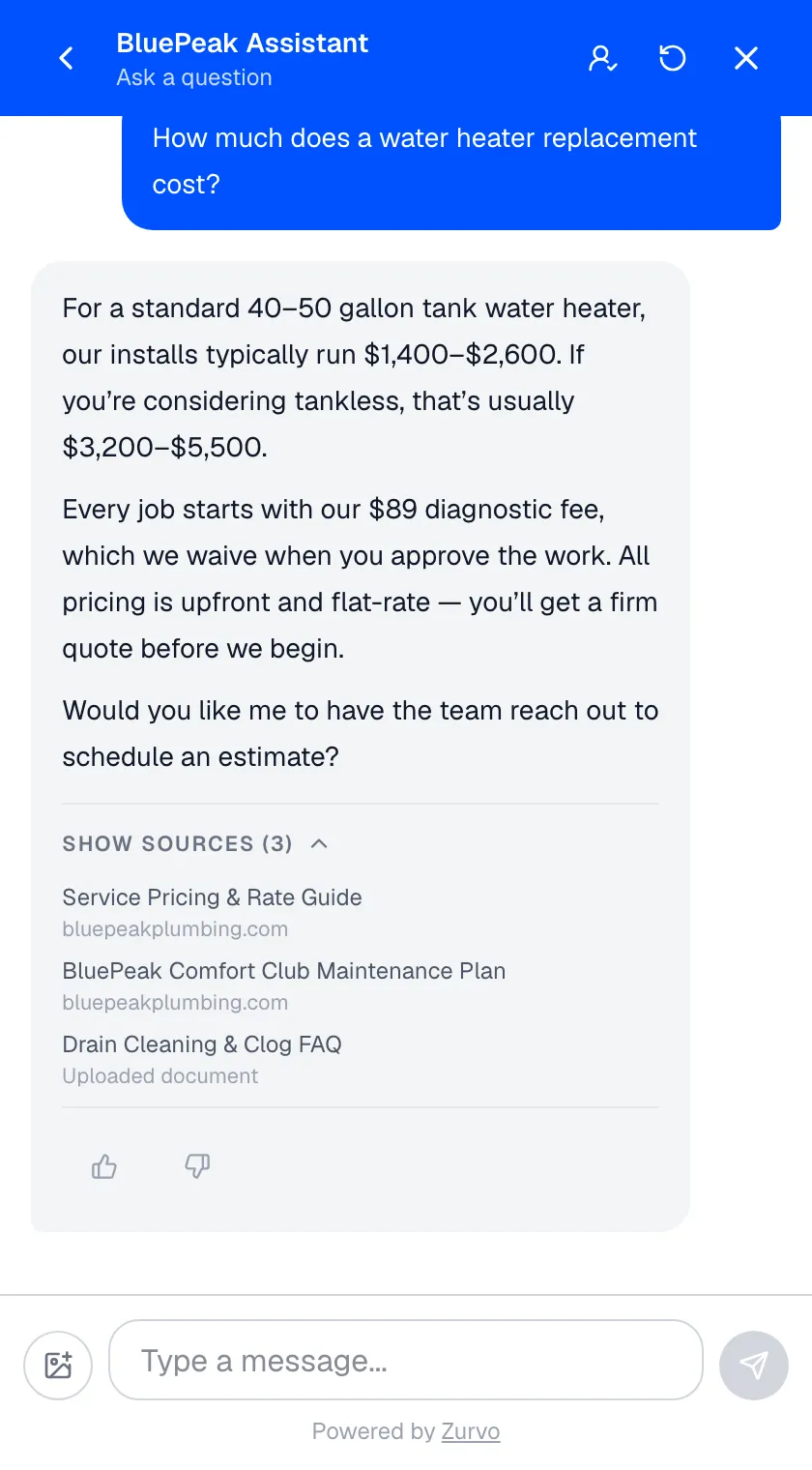
An AI agent for customer service is software that understands a customer’s question, finds the answer in a business’s own content, responds in natural language, and hands the conversation to a human when it can’t help. Unlike a scripted chatbot that walks customers through fixed decision trees, an AI agent works over your knowledge base to answer open-ended questions the way a customer actually asks them — which is the whole reason “agents” have replaced “bots” in serious support conversations.
Zurvo’s AI agents answer from your own content, show the sources behind each reply, and hand off to your team when they can’t help. This page is about the agentic shift — what makes an agent different from the chatbots that came before, and why that difference is the point.
Scripted bots vs. AI agents.
The chatbots most people have suffered through are rule-based. Someone maps out expected questions, writes canned responses, and wires up decision trees. The moment a customer phrases a question a way nobody anticipated, the bot falls back to “I didn’t understand that” or dumps them into a menu. These bots don’t understand; they match. They scale poorly because every new question needs a human to script it.
An AI agent is different in kind. It interprets the intent behind a question, retrieves the passages of your content most relevant to it, and composes a specific answer — even for phrasings no one scripted. It doesn’t need a decision tree because it reasons over your knowledge directly. And critically, it knows the boundary of what it can answer: when your content doesn’t support a confident reply, it hands off instead of hallucinating.
What makes an agent safe to deploy.
Agentic power cuts both ways: an agent that reasons freely can also reason its way into a confident, wrong answer. Zurvo constrains its agents so the power stays safe:
- Answers come from your approved content only — crawled pages, uploaded documents, an approved business profile — never the open web or training data.
- Sources are shown on grounded replies, so any answer can be verified. See grounded AI answers.
- The agent abstains and hands off when evidence is thin. Abstaining is a feature, not a failure — it’s the difference between an agent you can trust and one you have to babysit.
How Zurvo’s AI agents work.
- Give the agent knowledge. Crawl your website (100 to 1,000 pages by plan) or upload help articles, policies, and FAQs. Zurvo builds a business profile automatically and re-crawls to stay current.
- Deploy it. Paste one embeddable widget snippet onto your site, help center, or app. The agent answers instantly, any hour, in your brand’s tone.
- Let it reason over your content. Customers ask in their own words; the agent retrieves the relevant knowledge and answers specifically, with the source attached.
- Hand off with context. When the agent can’t help, the conversation routes to your team inbox with the transcript and an AI summary.
Agents improve through their handoffs.
Every time an agent hands off, it’s telling you something your content doesn’t answer yet. Zurvo’s AI Insights surface those recurring gaps so you can close them, and analytics show where the agent succeeds and where it escalates. Unlike a scripted bot that only improves when a human writes new rules, an AI agent improves as your knowledge gets more complete — a much faster loop.
Why abstaining is the feature that matters most.
It sounds backwards to praise an AI agent for not answering, but abstaining well is the hardest and most valuable thing an agent does. The failure mode that ends AI deployments isn’t the question the agent couldn’t answer — it’s the question it answered confidently and wrong. A customer who’s told “yes, that’s covered under your plan” when it isn’t, or given a setup step that breaks their account, does more damage than one who’s told “let me get a person for that.” Zurvo’s agents are tuned to recognize when the retrieved evidence is too thin to support a confident answer and to hand off rather than fill the gap with a plausible guess. That single behavior is what lets you put an agent in front of customers unsupervised. An agent that never says “I don’t know” isn’t more capable — it’s more dangerous, because it will eventually say something untrue with total confidence.
An honest note on limits.
Zurvo’s agents answer questions and route conversations. They are not general-purpose agents that take actions in your backend — they won’t process a refund or change an order on their own. Their accuracy depends on your content. And the platform provides tenant isolation, encryption, RBAC, and audit logs, but does not currently hold SOC 2 or HIPAA certification; those are roadmap items, described honestly on security and control.
Where AI agents fit best.
- Support queues full of open-ended questions that scripted bots can’t handle.
- Teams tired of maintaining decision trees for every new question.
- Businesses that want agentic answers they can trace to their own content.
Related reading: ai customer service software, customer support chatbot, and customer support bot.
The bottom line.
The move from scripted bots to AI agents is the move from matching keywords to understanding questions — and from hoping a bot won’t embarrass you to knowing it will abstain when it should. Zurvo’s agents are built for that standard.
See how it works, review pricing, or try it live to watch an agent answer on your own content.