
Customer Support Software.
Customer support software helps teams answer, automate, and resolve questions. See how AI support software that answers from your content deflects tickets.
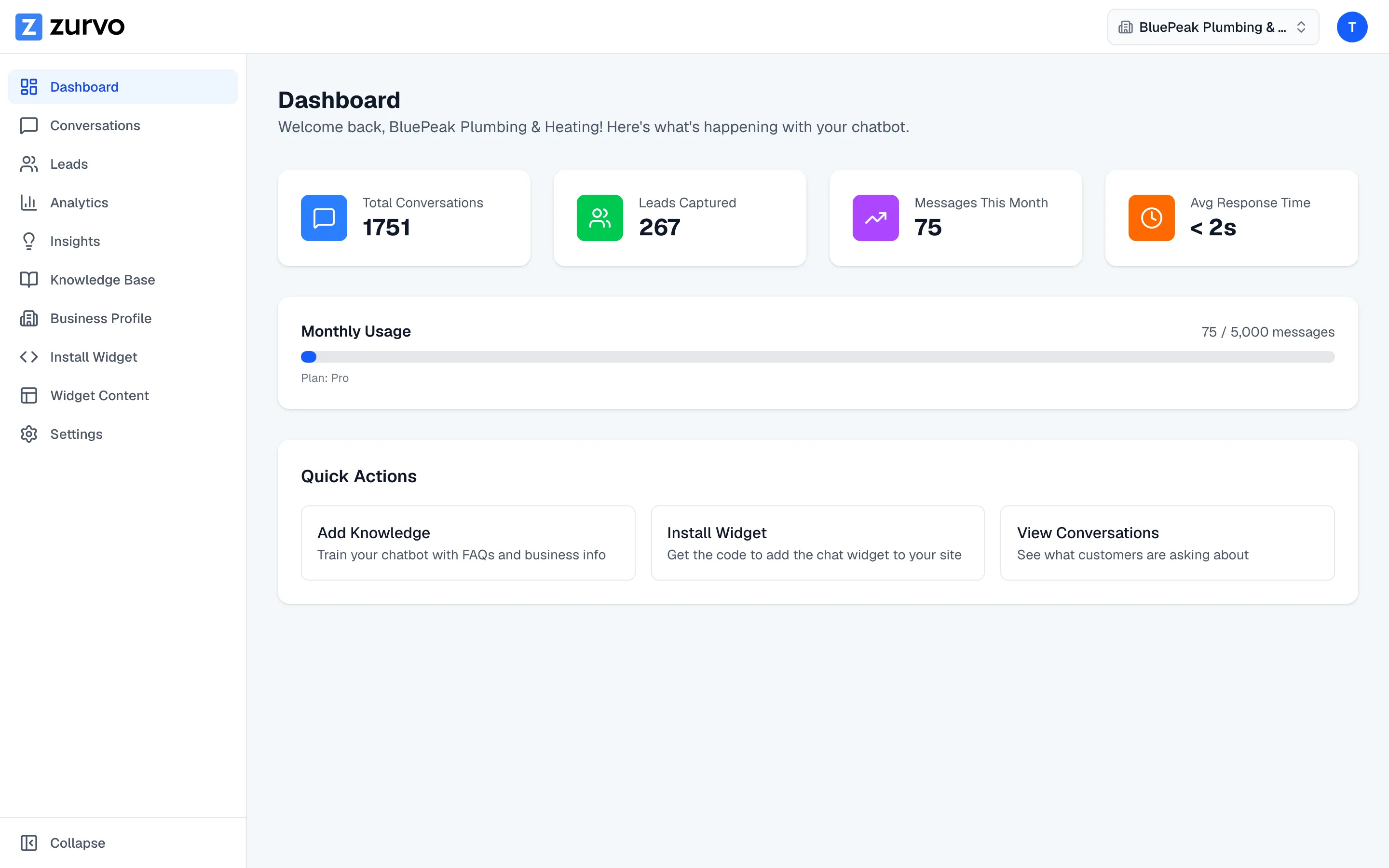
Customer support software is a platform that helps a business receive, manage, and resolve customer questions across channels — combining a knowledge base, a shared inbox, automation, and analytics so every request is handled. Over the last few years the category has shifted from purely human-staffed ticketing toward AI-first support, where an AI agent handles the repetitive volume and a human handles everything that needs judgment. This page takes the broad, platform-level view: what the category covers and how Zurvo brings the pieces together.
Zurvo is customer support software that answers from your own content, shows the source of each reply, and hands off to a person when it can’t help. It’s built so the AI layer and the human layer share one knowledge base and one inbox, rather than bolting a chatbot onto a legacy help desk.
The pieces a support platform has to cover.
A complete support platform isn’t one feature — it’s several working together. Here’s the category, and how Zurvo covers each part:
- Knowledge. The source of truth answers come from. Zurvo’s knowledge base is built by crawling your site (100 to 1,000 pages by plan) and uploading documents, with scheduled re-crawls to stay current.
- Answering. The layer that resolves questions. Zurvo’s grounded AI answers from your knowledge, shows sources, and abstains when evidence is thin.
- A place to talk. Where customers reach you. An embeddable chat widget and widget hub sit on your site, help center, or app.
- A human layer. For everything the AI shouldn’t resolve. Human handoff and a team inbox provide SLA tracking, assignment, canned replies, internal notes, and summaries.
- Measurement. To know what’s working. Analytics and insights show deflection, handoffs, and content gaps.
- Governance. For teams and access. Team roles, custom roles, and multi-org support, with per-tenant security controls.
Why an AI-first platform beats a chatbot bolted onto a help desk.
Many teams end up with a legacy ticketing system and a separate chatbot that don’t share knowledge. The chatbot improvises answers the help desk’s articles could have grounded; the help desk tracks tickets the chatbot could have deflected. The seams show to the customer.
Zurvo is designed as one system. The same knowledge base that grounds the AI’s answers is available to your agents in the inbox. When the AI hands off, the human sees the full transcript and an AI summary — no re-explaining. When the human answers something the AI couldn’t, AI Insights can surface it as a content gap to close. The AI layer and the human layer reinforce each other instead of duplicating work.
How Zurvo works end to end.
- Load knowledge. Crawl your site or upload documents; Zurvo builds a business profile automatically.
- Deploy the front line. Paste one embed snippet. The AI answers instantly, any hour, in your brand’s tone.
- Resolve and route. Repetitive questions get grounded answers with sources; everything else routes to the team inbox with context.
- Capture and measure. Lead capture turns interested visitors into pipeline, and analytics show what to improve.
Pricing you can plan around.
Support software often hides its cost, forcing a sales call before you can even compare. Zurvo doesn’t. Plans are priced by message volume, with monthly or annual billing (annual saves 20%): Launch at $39 for 500 messages, Growth at $89 for 3,000, and Scale at $179 for 12,000, and every plan includes a 3-day trial. Crawl limits scale with the plan too — 100, 300, or 1,000 pages — so the amount of knowledge the software can hold grows as you move up. That transparency lets you model the cost of an AI-first support stack against your actual ticket volume before you commit, rather than negotiating it. See pricing for the full comparison, and note there’s no opaque “enterprise” tier behind a contact-us wall — the same transparent plans apply as you scale into team roles and multi-org.
An honest note on limits.
Zurvo is an AI-first support layer: it answers questions, routes conversations, and captures leads. It is not a general-purpose agent that acts on your backend systems, and it does not replace every workflow a mature legacy help desk might run. Its answers depend on your content. The platform isolates data per tenant with encryption, RBAC, and audit logs, but does not currently hold SOC 2 or HIPAA certification — those are roadmap items, described honestly on security and control.
Capturing more than support along the way.
Support software is usually framed purely as a cost center — a way to handle problems. But the same widget that answers a support question is also talking to prospects who arrived with pre-sale questions, and treating those as pure support wastes them. Zurvo folds lead capture into the same conversation surface: when a visitor shows buying intent, the agent can capture their details in the flow or present a proactive form, and those leads land in a pipeline you can work and export to CSV. That means your support software quietly doubles as a top-of-funnel capture tool, turning the traffic that would have bounced off a contact form into named leads for your team. It’s a reminder that in an AI-first stack the line between “support” and “sales” conversations is thinner than the org chart suggests — and software that serves both from one widget gets more value out of every visitor.
Where it fits best.
- Teams standardizing on an AI-first support stack rather than patching a legacy help desk.
- Businesses that want the AI layer and human layer to share one knowledge base and inbox.
- Operations that need deflection, clean handoffs, and measurement in one place.
Related reading: customer support automation, ai customer service software, and helpdesk automation.
The bottom line.
The best customer support software isn’t the one with the longest feature list — it’s the one where knowledge, answering, humans, and measurement work as one system. Zurvo is built that way.
See how it works, compare pricing, or try it live to see the full platform on your own content.