
Customer Support Automation.
Customer support automation deflects repetitive tickets with an AI agent that answers from your knowledge, shows sources, and hands off to a human.
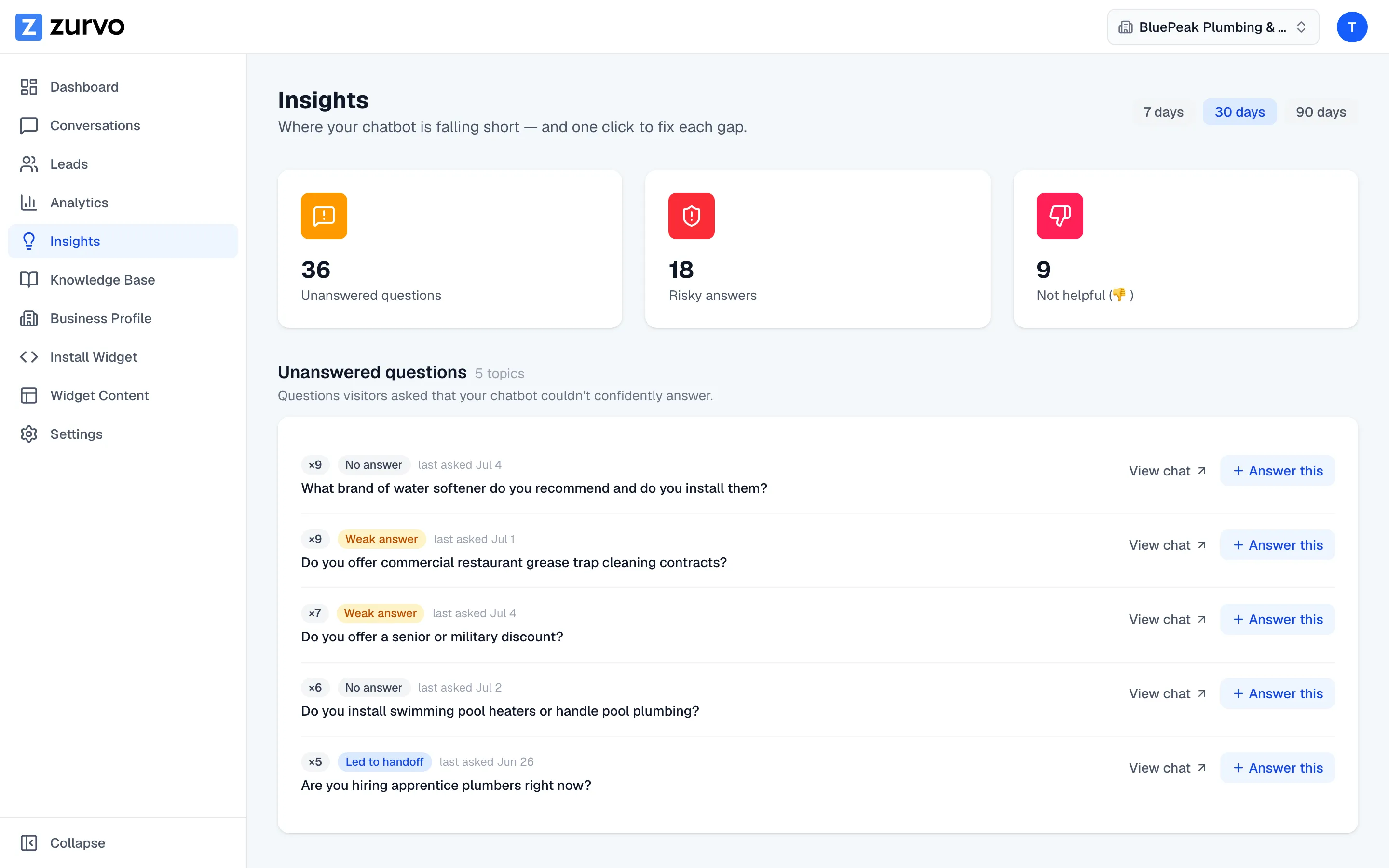
Customer support automation is the practice of answering the repetitive, well-documented questions that fill most support queues with an AI agent, so your team spends its hours on the cases that actually need a person. Where’s my order, how do I reset my password, what’s covered under my plan, how do I cancel — these tickets are predictable and already answered somewhere in content you maintain. Yet they consume agent hours, inflate first-response times, and bury the genuinely complex cases that need human judgment.
Zurvo automates that repetitive layer. An AI agent answers customers around the clock, drawing each response from your own approved knowledge base, showing the source for each answer, and handing the conversation to your team when it can’t help. The result is faster resolution, lower ticket volume, and a support experience tied to exactly what you’ve published — not to a model’s guesswork.
This is the flagship Zurvo use case, and it rests on one simple idea: an automated agent is only useful if it answers from content you control.
Why “answers from your content” is the whole game.
A general-purpose model that improvises can confidently tell a customer something wrong — a refund policy that doesn’t exist, a setup step that breaks their account, a discount you never offered. One hallucinated answer can cost you a chargeback, a complaint, or a customer. Automation that isn’t grounded doesn’t save your team time; it creates a new class of cleanup work.
Zurvo keeps answers tied to your content by design:
- Answers come from your approved knowledge, not the open internet or a model’s training data. If the answer isn’t in your content, the agent doesn’t invent one.
- Sources are shown. A “Show sources” link reveals the exact page or document behind each reply, so customers and your team can verify it in a click.
- The agent abstains and hands off when your content doesn’t cover a question, rather than guessing.
That is the difference between a chatbot that merely deflects tickets and an agent whose every answer traces back to something you actually wrote. Read more about the engine on grounded AI answers.
How customer support automation works with Zurvo.
- Add your knowledge. Upload your help center, policy documents, product guides, and FAQs (PDF, DOCX, PPTX, TXT, and Markdown), or let Zurvo crawl your website and build a business profile automatically. Depending on your plan, crawls cover 50, 200, 500, or 1,000 pages, and Zurvo re-crawls on a schedule so answers stay current as your content changes. Your knowledge stays isolated to your own account.
- Deploy on your site. Paste one embeddable widget snippet onto your website, help center, or app. The agent answers instantly, any hour, in a tone that matches your brand.
- Deflect the repetitive volume. Order status, account questions, policy explanations, troubleshooting steps, plan details — the questions that make up the bulk of your queue get answered from your content, with the source attached.
- Hand off cleanly when a human is needed. When the agent can’t help, when a customer asks for a person, or when a conversation crosses a threshold you set, it routes to your team inbox with the full transcript and an AI-generated summary, so the agent picks up with full context and the customer never repeats themselves.
Deflect more over time with the fix-loop.
Automation isn’t a set-and-forget install. The questions where your agent had to hand off are the most valuable signal you have — they tell you exactly what your content doesn’t yet answer. Zurvo’s AI Insights surface those recurring gaps so you can add the missing article or policy, then watch the next wave of those questions get deflected. Over weeks, the deflection rate climbs not because the model got smarter, but because your knowledge got more complete.
Analytics sit alongside this, showing what’s being deflected, where the agent hands off, and which content to improve next. Deflection rate only counts when customer satisfaction holds steady beside it — so you watch both together.
Keep a human in the loop where it matters.
Full automation is the wrong goal for every conversation. Sensitive accounts, edge-case policy questions, and anything requiring genuine judgment should reach a person — quickly and with context. Zurvo’s team inbox gives your agents SLA tracking, assignment, canned replies, internal notes, and conversation summaries, so escalations are fast and nothing falls through. When a handoff happens, your team can be notified by email and via a Slack incoming webhook, carrying the visitor info and summary so they can triage before opening the dashboard.
The point of automating support is not to remove humans — it’s to stop wasting them on the thousandth identical question so they’re free for the ones only a person can handle.
An honest note on limits.
Zurvo automates the repetitive, documented layer of support extremely well. It is not a general-purpose agent that acts on your systems — it answers questions and routes conversations; it does not process refunds or change orders on its own. Its answers are only as good as the content you give it, which is why the knowledge base and the fix-loop matter. And on security: your data is isolated per tenant with encryption, role-based access, and audit logs, but Zurvo does not currently hold SOC 2 or HIPAA certification — those are roadmap items, and we won’t claim otherwise. You can read the full posture on security and control.
Where it delivers the most value.
Support automation pays off fastest for teams with high ticket volume and well-documented answers:
- High-volume account, billing, and troubleshooting queues.
- Queues full of repeated eligibility and coverage questions.
- Products whose customers expect instant, precise answers at every hour.
- Operations where careful, context-rich escalation matters.
Related reading: ticket deflection, helpdesk automation, and customer support automation software for the buyer’s-guide angle.
The outcome
Teams that automate the repetitive layer with an agent that answers from their content aim for real deflection on their most common question types, shorter response and resolution times, and answers they can trace. Your agents stop answering the same question for the thousandth time and start handling the work only a human can do.
Answers from your content. Sources shown. A human in the loop when it counts. See how it works or check pricing — plans from $39/mo with a 3-day trial.
Try it live to see support automation answering from your own content.