
Customer Self Service Software.
Customer self service software lets customers find answers on their own, any hour. See how AI-powered self-service answers questions and shows its sources.
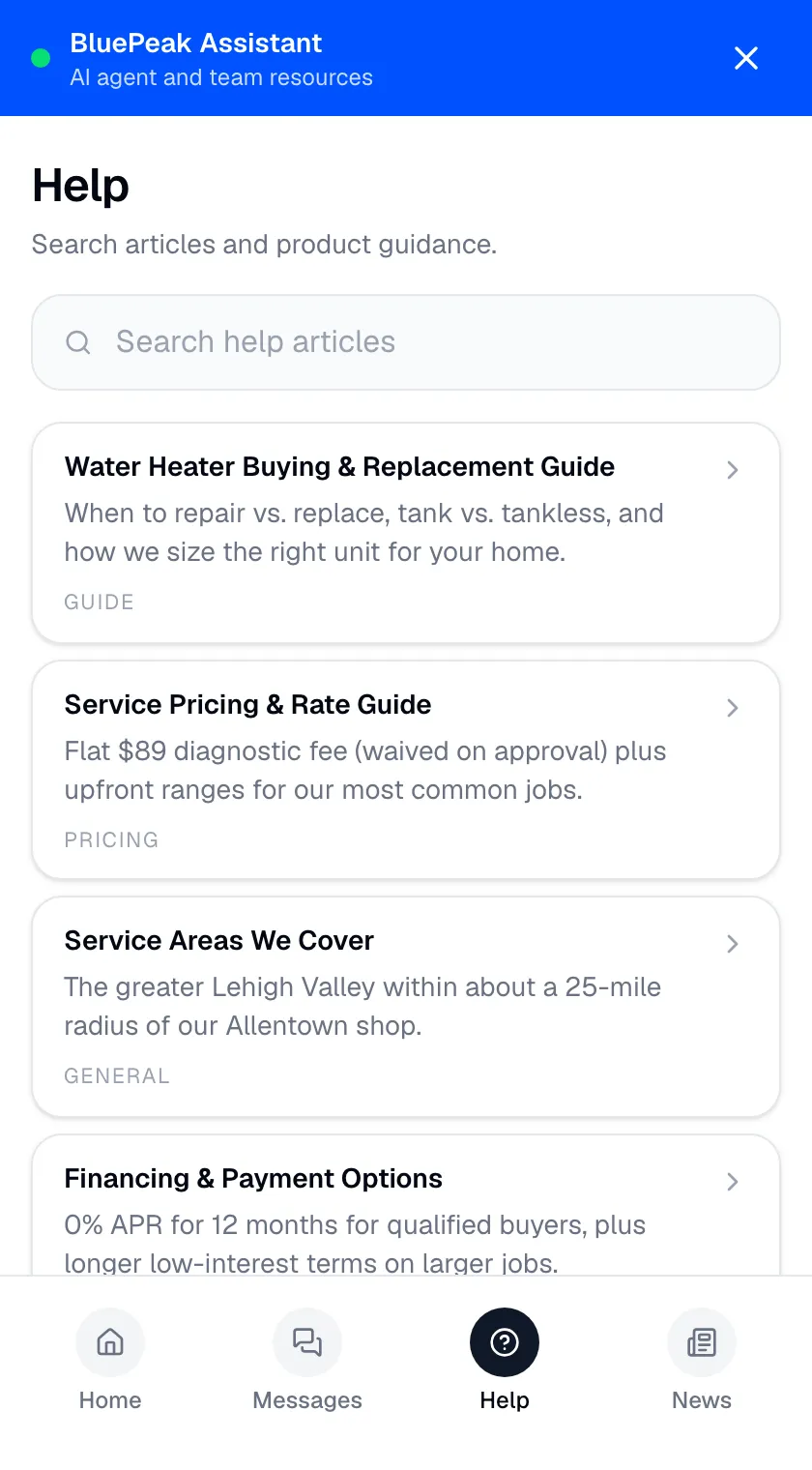
Customer self-service software lets customers find answers to their own questions — without contacting an agent — through a knowledge base, help center, or AI assistant available around the clock. The category has moved well beyond static help articles. The most effective self-service today is conversational: instead of handing a customer a list of ten articles to read, it answers their specific question in plain language, right when they ask it.
Zurvo is AI-powered customer self-service software. Rather than making customers search, it answers their question from your own content, shows the source, and hands off to a human when it can’t help. This page is about the self-service angle — resolving questions before they ever reach your team, without leaving customers stranded.
Why static self-service falls short.
A traditional help center puts all the work on the customer. They have to guess the right search terms, scan a list of results, open the likely article, and interpret whether it actually answers their situation. For a simple question, that’s a lot of friction — and every point of friction is a customer who gives up and files a ticket instead. Worse, when the articles are slightly out of date or don’t cover an edge case, the customer either acts on wrong information or contacts support anyway.
Static self-service deflects only the customers patient and lucky enough to find the answer themselves. Everyone else becomes a ticket. That’s a low ceiling.
How conversational self-service raises the ceiling.
Conversational self-service removes the search-and-interpret step. The customer asks their actual question; the agent answers it. Zurvo makes that answer trustworthy:
- It answers from your own content, not the open web or a model’s guesswork.
- It shows the source behind each reply, so the customer can verify it — see grounded AI answers.
- It abstains and hands off when your content doesn’t cover the question, so self-service never becomes a dead end.
Because it answers the specific question rather than returning a list, conversational self-service deflects far more of your queue than a search box ever could — while keeping a clean path to a human for the questions that need one.
How Zurvo delivers self-service.
- Add your knowledge. Crawl your site (100 to 1,000 pages by plan) or upload help articles, policies, and FAQs. Zurvo builds a business profile automatically and re-crawls to stay current.
- Offer chat and browsing together. The chat widget and widget hub can include AI chat, a help center, and news, so customers can ask a question or browse articles — whichever they prefer.
- Answer the specific question. Customers get grounded answers from your content, any hour, with the source attached.
- Hand off cleanly. When self-service can’t resolve it, the conversation routes to your team inbox with the transcript and an AI summary, so nobody hits a wall.
Good self-service vs. bad self-service.
The line between good and bad self-service is simple: good self-service resolves the question; bad self-service just hides the contact form. A tool that buries your “talk to a human” link and counts a frustrated, abandoned session as a deflection isn’t helping — it’s stacking up churn you’ll pay for later. Zurvo is built on the opposite principle: deflect by answering, and hand off the moment answering isn’t enough. Watch your deflection rate alongside customer satisfaction in analytics, and let AI Insights show you which content to add to deflect more without frustrating anyone.
Self-service that keeps improving.
The reason most self-service plateaus is that nobody knows what it’s failing to answer. A static help center gives you no signal — a customer who couldn’t find an answer just leaves or files a ticket, and the gap stays invisible. Conversational self-service closes that blind spot. Every time Zurvo’s agent hands off because your content didn’t cover a question, it’s telling you exactly what article or policy is missing. AI Insights collect those into a ranked list, so improving self-service becomes a concrete task list instead of guesswork. Add the missing content, and the next customer who asks that question gets a self-service answer instead of becoming a ticket. Over a few cycles, your deflection rate climbs — not because you restricted access to support, but because your self-service actually got more complete. That’s the compounding advantage of self-service that reports its own gaps.
An honest note on limits.
Zurvo answers questions and routes conversations for self-service; it does not act on your backend systems. Its accuracy depends on the content you give it. The platform isolates data per tenant with encryption, RBAC, and audit logs, but does not currently hold SOC 2 or HIPAA certification — those are roadmap items, described plainly on security and control.
Where self-service software fits best.
- Products with high volumes of simple, documented questions.
- Teams whose help center exists but under-deflects because customers can’t find answers.
- Businesses that want to deflect more without hiding access to a human.
Related reading: ticket deflection, automated customer service, and customer support software.
The outcome
Conversational self-service answers the question your customer actually asked, resolves more of your queue than a search box, and hands off cleanly when it can’t help. Self-service that helps instead of hides.
See how it works, check pricing — plans from $39/mo with a 3-day trial — or try it live to see it on your own content.