
Ticket Deflection.
Ticket deflection resolves questions via self-service before they become tickets. See how AI that answers from your content raises deflection rate.
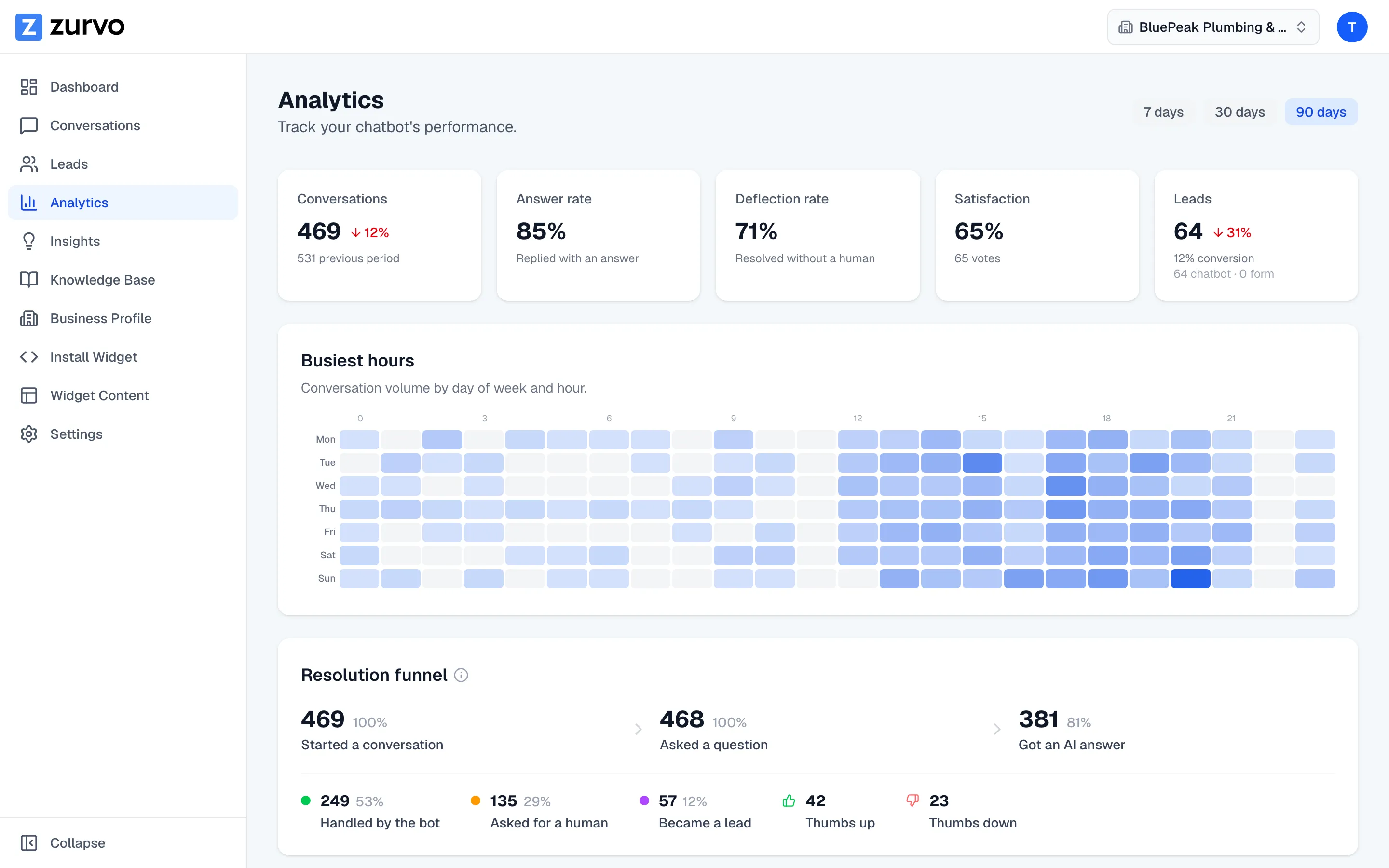
Ticket deflection is the practice of resolving a customer’s question through self-service or automation before it becomes a support ticket, lowering volume in the queue while still giving the customer a fast answer. The metric that tracks it — deflection rate — is one of the clearest signals of a healthy support operation, but only when deflection means answered, not abandoned. This page is about the metric: what it really measures, how to move it, and how to avoid gaming it.
Zurvo deflects tickets with an AI agent that answers from your own content and hands off to a human when it can’t help, so the question is resolved, not just diverted.
What ticket deflection actually measures.
Deflection happens when a customer gets the answer they need without an agent having to handle it. It can come from a help article they find, a self-service flow, or an AI agent that answers their specific question in conversation. The point isn’t to block customers from reaching support — it’s to make support unnecessary for the questions that have a clear, documented answer.
The trap is measuring diversion instead of resolution. If you hide the contact form, deflection rate goes up while your customers get angrier. That’s why deflection rate is only meaningful next to customer satisfaction: a rising deflection rate with steady CSAT is the goal; a rising deflection rate with falling CSAT is a warning you’re deflecting people, not questions.
Good deflection vs. bad deflection.
- Bad deflection buries the “talk to a human” link, counts a frustrated, abandoned session as a win, and shows up later as churn and negative reviews.
- Good deflection actually resolves the question and hands off cleanly when it can’t. It raises the rate by answering more, not by blocking more.
Zurvo is built for the second kind. It deflects by answering the customer’s real question from your content, and it routes to a human the instant answering isn’t enough.
How AI ticket deflection works with Zurvo.
- Add your content. Crawl your site (100 to 1,000 pages by plan) or upload help articles, policies, and FAQs. Zurvo builds a business profile automatically and re-crawls to stay current.
- Answer at the point of contact. The embeddable widget answers the customer’s question instantly, any hour, with the source shown — see grounded AI answers.
- Resolve the repetitive volume. Order status, password resets, plan details, and troubleshooting — the predictable bulk of the queue — get handled without an agent.
- Hand off when it can’t help. When your content doesn’t cover the question, the agent hands off to your team inbox with the transcript and an AI summary, so the customer never hits a dead end.
How to measure and improve deflection rate.
Deflection rate is the share of customer questions resolved through self-service or automation without an agent touching them. Track it alongside CSAT, first-response time, and resolution time. Zurvo’s analytics show what’s being deflected and where the agent hands off, and AI Insights turn those handoffs into a list of content gaps to close. To move the number the right way:
- Close content gaps. The questions where the agent handed off tell you exactly what’s missing. Add it.
- Answer specifically, not generically. A conversational agent that answers the exact question deflects more than a search box returning ten articles.
- Keep content current. Stale content produces wrong answers or unnecessary escalations, both of which drag the rate down.
- Show sources. Customers accept an answer more readily when they can see where it came from.
The deflection fix-loop in practice.
Deflection rate isn’t a number you set once — it’s the output of a loop you run continuously. The loop has three steps. First, deflect what your content already answers: the agent handles those the moment they come in. Second, capture what it can’t: every handoff is logged as a question your knowledge didn’t cover. Third, close the gap: AI Insights rank those recurring misses so you know which piece of content will deflect the most tickets if you add it. Add it, and that question’s next wave gets deflected automatically. Run the loop for a few weeks and your deflection rate rises steadily, because each cycle converts a category of handoffs into a category of self-service answers. The teams that get the most out of deflection aren’t the ones with the cleverest bot — they’re the ones who treat the handoff log as a to-do list and actually work it.
An honest note on limits.
Deflection depends on your content. Zurvo can only deflect a question your knowledge actually answers — which is exactly why the fix-loop matters. And the agent deflects by answering and routing; it doesn’t act on your backend systems. The platform isolates data per tenant with encryption, RBAC, and audit logs, but does not currently hold SOC 2 or HIPAA certification — those are roadmap items, described plainly on security and control.
Where deflection pays off most.
- High-volume queues dominated by repetitive, documented questions.
- Teams under pressure on first-response and resolution times.
- Operations that want to raise deflection without sacrificing satisfaction.
Related reading: helpdesk automation, customer self service software, and customer support automation.
The bottom line.
Deflection rate is only worth chasing if it means questions resolved, not customers blocked. Zurvo raises the rate by answering from your content and handing off cleanly — deflection that holds up next to your CSAT number.
See how it works, check pricing, or try it live to see deflection working on your own content.