
Employee Knowledge Assistant.
Employee knowledge assistant gives staff answers from your internal docs, with sources and escalation to the right team when it can't help.
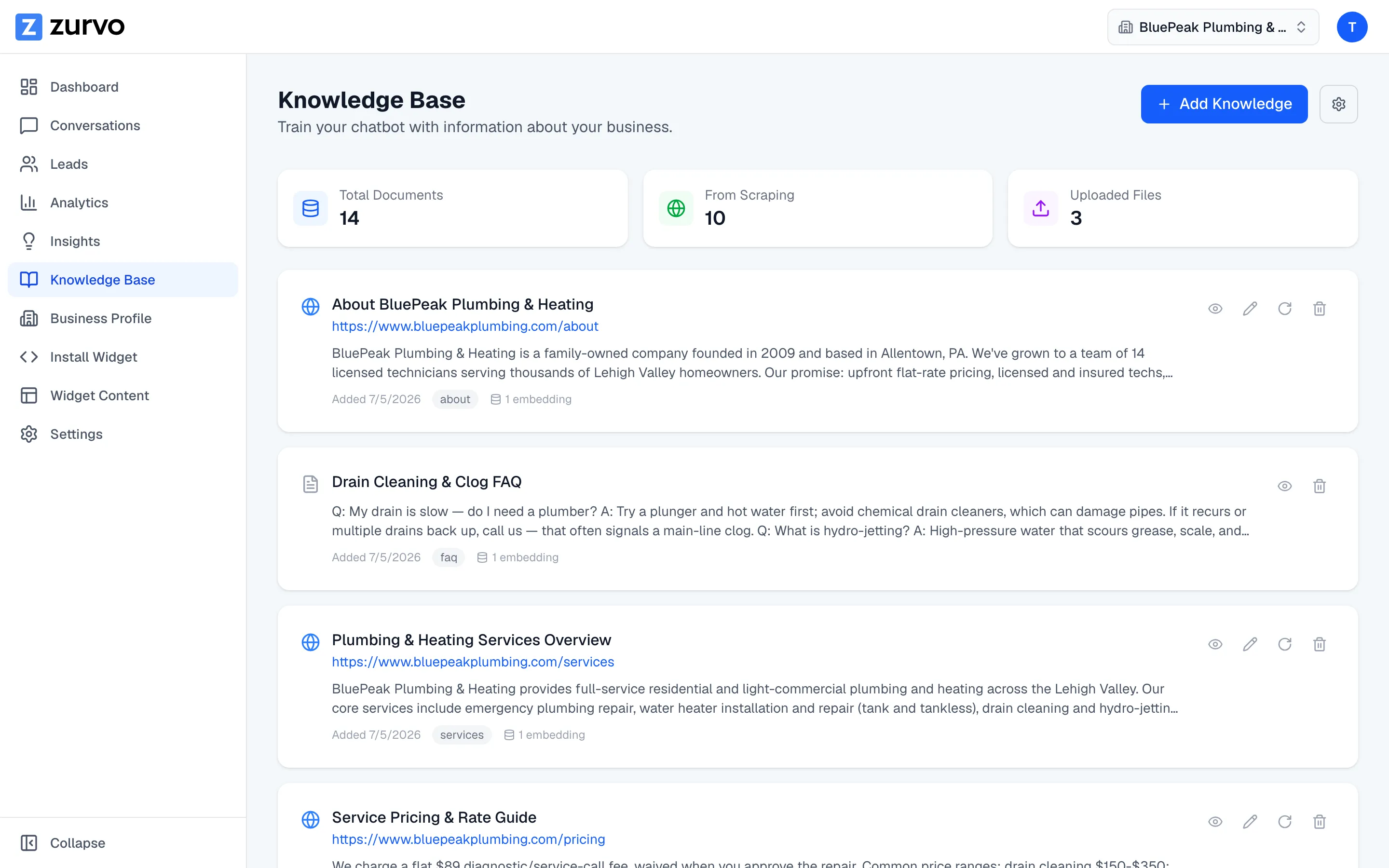
An employee knowledge assistant is an internal AI agent that answers staff questions from your own approved internal documents, shows the source, and escalates to the right team when it can’t help. Where’s the latest expense policy, which form do I use for a security exception, what’s the PTO accrual rule, how do I escalate a customer issue — the information exists, but it’s scattered across an intranet, a wiki, a shared drive, and a dozen PDFs, and finding the current version is slow. So employees ask a colleague, file an internal ticket, or guess.
Zurvo gives your workforce an employee knowledge assistant that answers from your approved internal documents, shows where each answer came from, and escalates to the right team when it can’t help. Employees get self-service answers in seconds, and your HR, IT, and operations teams field fewer repetitive internal questions.
Why internal answers have to be verifiable.
When an external chatbot gets something wrong, a customer is inconvenienced. When an internal assistant gets a benefits rule, a security process, or an approval step wrong, an employee acts on it — and the consequences land inside your business: a mis-filed exception, a missed deadline, a policy applied incorrectly at scale. Internal answers carry operational weight, which is exactly why they can’t be improvised.
Zurvo answers from your own documents and shows the source behind each reply, so an employee can verify a policy answer before acting on it. When the documents don’t clearly support an answer, the assistant abstains and escalates rather than guessing — because a confident wrong answer about an internal process is worse than no answer at all.
How the employee knowledge assistant works.
- Load your internal knowledge. Upload policy documents, runbooks, wikis, and FAQs (PDF, DOCX, PPTX, TXT, Markdown), or crawl internal pages you approve. Zurvo builds a knowledge base and keeps it current.
- Give staff a place to ask. Employees ask their question in plain language and get a grounded answer with the source attached — see grounded AI answers.
- Answer the repetitive internal volume. Expense policy, PTO rules, IT processes, security exceptions, onboarding steps — the questions that flood HR, IT, and ops inboxes — get answered directly.
- Escalate to the right team. When the assistant can’t help, it routes to a human on the right team with context, via the team inbox, so nothing dead-ends.
Fewer internal tickets, faster answers.
The payoff is on both sides. Employees stop losing hours hunting for the current version of a document or waiting on a colleague to reply. HR, IT, and operations stop answering the same internal questions over and over and get their time back for real work. AI Insights surface the questions the assistant couldn’t answer, so you know which internal documentation to improve, and analytics show what staff ask most.
Keeping internal data controlled.
Internal knowledge is sensitive, so control matters as much as answers. Zurvo isolates your data to your own tenant with row-level security, scopes access with role-based controls and custom roles, and records sensitive actions in an audit log. To be precise about the security bar: these controls are live today, but Zurvo does not currently hold SOC 2 or HIPAA certification — those are roadmap items, described honestly on security and control.
Where it beats asking a colleague.
The default when an employee can’t find an answer is to ask a colleague — which quietly taxes your most knowledgeable people and produces inconsistent, half-remembered answers. Two people asked the same policy question get two different answers, and the one who guessed wrong finds out later. An employee knowledge assistant fixes both problems. Everyone gets the same answer, drawn from the same approved document, with the source attached so they can confirm the version is current. Your experienced staff stop being an unofficial help desk, and the answers stop drifting. Over time, the gaps the assistant surfaces through AI Insights become the prompt to document the tribal knowledge that only lived in a few people’s heads — turning informal expertise into content the whole organization can rely on.
An honest note on limits.
The assistant answers questions and routes them; it doesn’t take actions in your HR or IT systems on an employee’s behalf. Its accuracy depends entirely on the internal documents you give it — which is why keeping that content current matters. And, again, the security controls are real today but the formal certifications are roadmap, not current.
Rolling it out across teams.
Internal knowledge isn’t one pile — it’s HR’s policies, IT’s runbooks, operations’ procedures, each owned by a different team. Zurvo’s role-based access and multi-organization support let you reflect that structure rather than flatten it. You can scope who maintains which content, keep sensitive documents visible only to the right people, and separate business units so each team’s assistant answers from the right set of documents. That matters for adoption: employees trust an assistant that gives answers appropriate to their team and role, and content owners trust a system where they control their own material. Start with the highest-volume internal questions — usually HR and IT — prove the time savings, then extend to operations and beyond as you see which documentation the assistant surfaces as thin. A phased rollout, guided by the gaps AI Insights reveals, tends to land better than trying to load every document at once.
Where it fits best.
- Organizations whose internal knowledge is scattered across too many places.
- HR, IT, and ops teams buried in repetitive internal questions.
- Businesses that want staff self-service without risking answers on sensitive policies.
Related reading: enterprise chatbot, customer self service software, and customer support software.
The outcome
An employee knowledge assistant turns a scattered pile of internal documents into fast, verifiable answers — and turns repetitive internal tickets into self-service. Your staff get unblocked; your internal teams get their time back.
See how it works, review pricing, or try it live to see it answer from your own internal content.