
Enterprise Chatbot.
Enterprise chatbot answers customer and employee questions from approved content, shows its sources, hands off to a human, with RBAC and audit logs.
An enterprise chatbot is a conversational AI agent built for larger organizations — answering customer or employee questions from approved content, with the security and governance controls that enterprise IT and compliance teams require: role-based access, audit logs, and per-tenant data isolation. It handles support volume and self-service while meeting a bar that consumer-grade chatbots often don’t. This page is about that governance angle — what “enterprise” actually demands of a chatbot, and how Zurvo maps to it honestly.
Zurvo is an enterprise chatbot that answers from your approved content, shows the source behind each reply, and hands off to a human when it can’t help, on a multi-tenant platform with the access controls and auditability an enterprise deployment needs.
What “enterprise” really requires.
The word “enterprise” gets attached to a lot of chatbots that can’t back it up. In a large organization, a chatbot isn’t just judged on whether it answers well — it has to satisfy the people who sign off on it. IT wants data isolation and access control. Security wants defenses against the attacks that target AI systems. Compliance wants an audit trail. Support and CX want measurable deflection and clean escalation. A chatbot that nails the demo but fails those gates never gets deployed.
Two governance realities matter most for an enterprise chatbot: control over who can see and do what, and a record of what the bot answered and where it came from. Zurvo is built around both.
Governance controls Zurvo provides.
- Per-tenant data isolation. Every organization’s data — knowledge, conversations, leads — is scoped to its own tenant with row-level security. Your content trains nothing outside your own deployment.
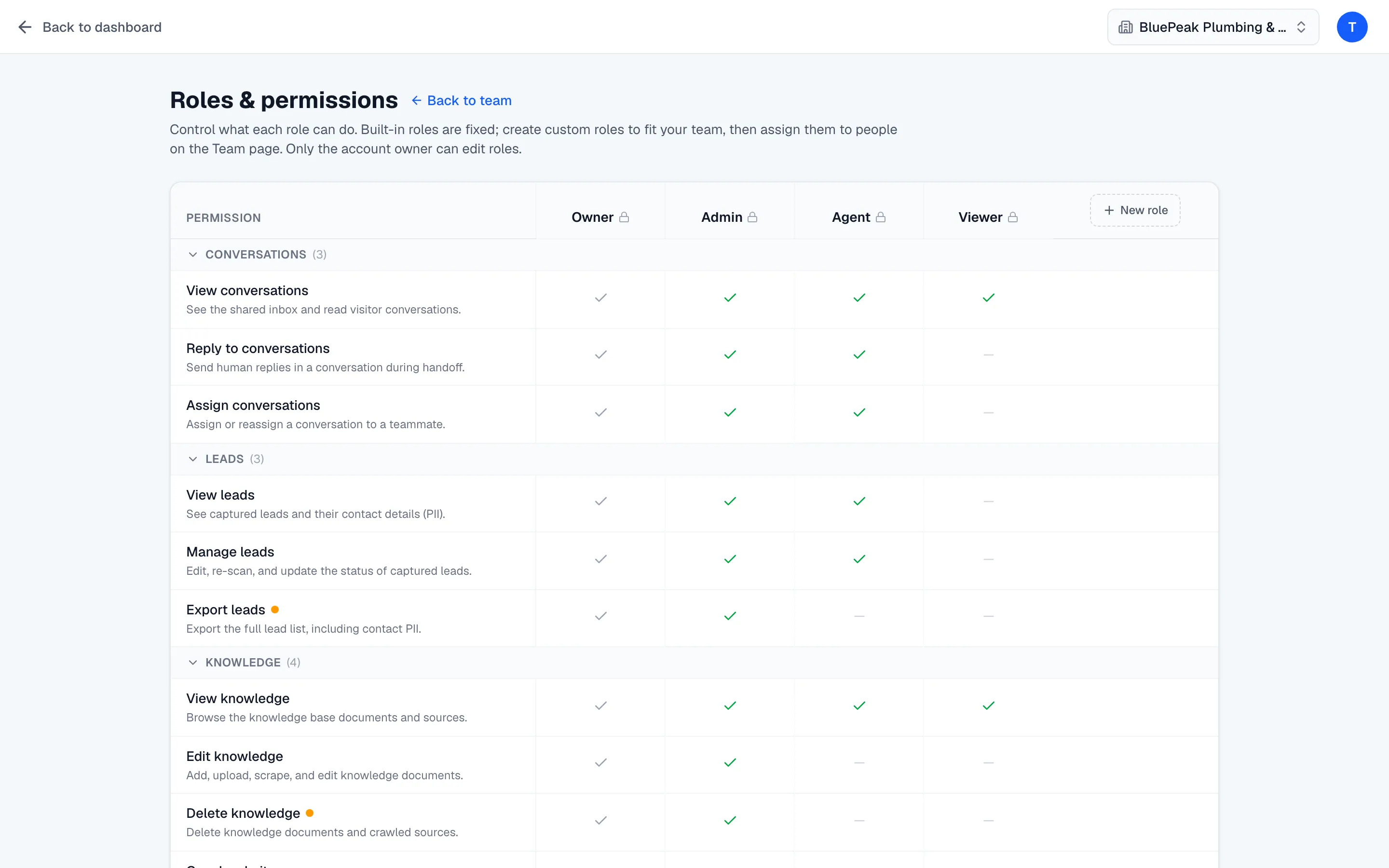
- Role-based access control. Team roles scope what each member can see and do, with custom roles for your structure and multi-organization support to separate business units.
- Audit logs. Sensitive actions are recorded — who did what, and when — so team activity is traceable.
- Auditable answers. Because the bot answers from your content and shows sources, you can trace not just team actions but what the chatbot said and where it came from. See grounded AI answers.
- AI-specific defenses. Scraped and uploaded content is sanitized and the system prompt is hardened against injection; the crawler has SSRF defenses; the app has CSRF protection and rate limiting. See security and control.
Being precise about what’s true.
Security reviews reward specifics that hold up. So here’s the honest line: Zurvo provides tenant isolation, RBAC, audit logs, encryption, and layered defenses today. It does not currently hold a SOC 2 attestation or HIPAA certification — those are roadmap items, and we won’t claim them. And Zurvo’s pricing is transparent and volume-based; there’s no opaque “enterprise plan” behind a contact-us wall. If a vendor claims certifications without that kind of specificity, treat it as a flag rather than reassurance.
How the enterprise chatbot works.
- Load approved content. Crawl your site (100 to 1,000 pages by plan) or upload documents; Zurvo builds a business profile and re-crawls to stay current.
- Set up access. Assign team roles, define custom roles, and separate business units with multi-org support.
- Deploy. Embed the chat widget for customers, or use the same grounded engine as an internal assistant for employees.
- Escalate and audit. Conversations the bot can’t handle route to the team inbox with context; sensitive actions and answers are logged for review.
One platform, customer and employee.
The same grounded-answer engine can power an external customer chatbot and an internal employee assistant, each scoped to its own content and access controls. A large organization can standardize on one platform for both without mixing data — see the employee knowledge assistant use case for the internal angle.
Answers you can defend in a review.
In a large organization, the question after “does the chatbot answer well?” is “can we defend what it said?” A chatbot that improvises leaves you with nothing to point to when an answer is challenged. Zurvo leaves a trail. Every grounded answer shows the source it came from, conversations are recorded, and sensitive team actions are captured in an audit log. So when someone asks why a customer was told a particular thing, you can show the exact page the answer was drawn from and when — not a shrug about what a black-box model decided. That auditability is often the difference between a chatbot that clears a governance review and one that stalls in it. Combined with per-tenant isolation and role-based access, it gives IT, security, and compliance the specific, verifiable answers those reviews are designed to extract.
An honest note on limits.
Zurvo answers questions and routes conversations; it is not a general-purpose agent that acts on backend systems. Its accuracy depends on your content. And to repeat the point that matters for enterprise buyers: the security controls above are real today, but SOC 2 and HIPAA are roadmap, not current — the full, unvarnished posture is on security and control.
Where it fits best.
- Larger organizations that need governance, not just good answers.
- Teams that must show IT, security, and compliance a defensible posture.
- Businesses standardizing one chatbot platform across customer and employee use.
Related reading: customer support software, employee knowledge assistant, and customer support automation.
The bottom line.
An enterprise chatbot has to pass the people who guard the gates, not just impress the people who use it. Zurvo brings real governance controls and an honest account of what’s certified and what’s roadmap.
See how it works, review pricing, or try it live to see the controls and answers on your own content.